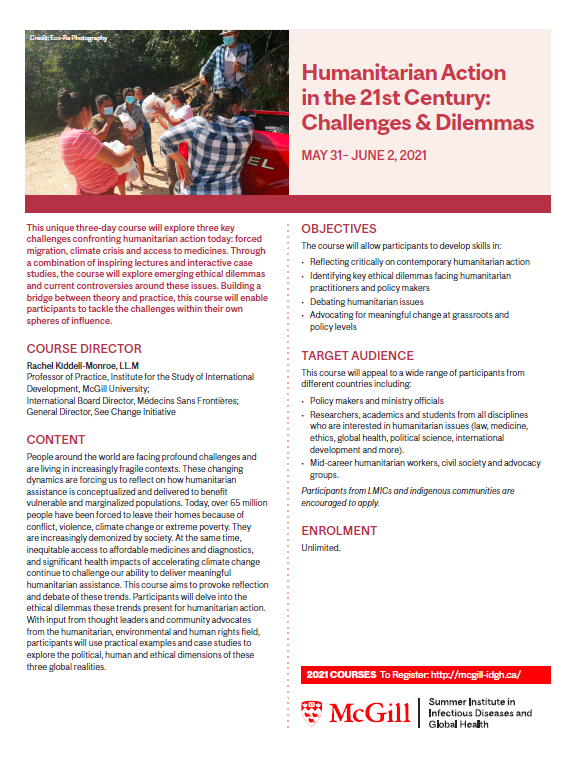
This unique three-day course will explore three key challenges confronting humanitarian action today: forced migration, climate crisis and access to medicines. Through a combination of inspiring lectures and interactive case studies, the course will explore emerging ethical dilemmas and current controversies around these issues. Building a bridge between theory and practice, this course will enable participants to tackle the challenges within their own spheres of influence.
Rachel Kiddell-Monroe, LL.M,
Professor of Practice, Institute for the Study of International Development, McGill University;
International Board Director, Médecins Sans Frontières;
General Director, See Change Initiative
James Orbinski, MD - Dahdaleh Institute for Global Health Research, York University
François Crépeau, O.C., F.R.S.C., Ad.E. - Hans & Tamar Oppenheimer Professor in Public International Law, McGill University, Director, McGill Centre for Human Rights and Legal Pluralism
Payam Akhavan, LLM SJD – Professor of International Law, McGill University and Member of the Permanent Court of Arbitration
Marine Buissonniere – Independent researcher and consultant
Eloge Butera – Senior Policy Advisor to Minister of Public Safety and Emergency Preparedness for Canada
Matthew Chapman – Climate Reality
Abdulla Daoud – Refugee Centre
Carol Devine, MSc – Médecins Sans Frontières
Jessica Farber – Samuel Center for Social Connectedness
Adam Houston – University of Ottawa
Matthew Hunt, PhD – School of Physical and Occupational Therapy, McGill University
Jerry Natanine – Former Mayor, Clyde River, Nunavut
John Pringle, PhD – Ingram School of Nursing, McGill University
Leo Tremblay – MSF water and sanitation specialist
Andrew Zadel – MSF Yemen Project Coordinator
Faculty are still being confirmed and there may be changes to the above list.
People around the world are facing profound challenges and are living in increasingly fragile contexts. These changing dynamics are forcing us to reflect on how humanitarian assistance is conceptualized and delivered to benefit vulnerable and marginalized populations. Today, over 65 million people have been forced to leave their homes because of conflict, violence, climate change or extreme poverty. They are increasingly demonized by society. At the same time, inequitable access to affordable medicines and diagnostics, and significant health impacts of accelerating climate change continue to challenge our ability to deliver meaningful humanitarian assistance. This course aims to provoke reflection and debate of these trends. Participants will delve into the ethical dilemmas these trends present for humanitarian action. With input from thought leaders and community advocates from the humanitarian, environmental and human rights field, participants will use practical examples and case studies to explore the political, human and ethical dimensions of these three global realities.
The course will allow participants to develop skills in:
The course will offer the opportunity to network with thought leaders and other participants.
This course will appeal to a wide range of participants from different countries including:
Participants from LMICs and indigenous communities are encouraged to apply.
Unlimited.